
Hoofed Aimals Frequently Seen In The Kruger
Giraffe
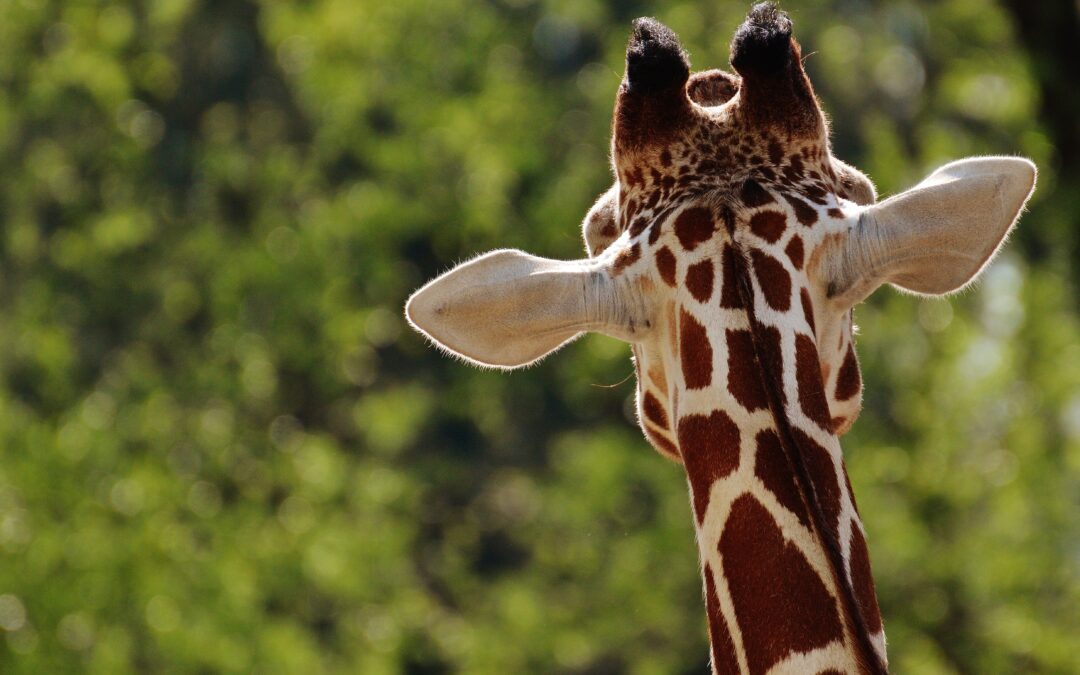
Giraffe (genus Giraffa) is a genus of four long-necked cud-chewing hoofed mammals native to Africa, with long legs and a coat pattern of irregular brown patches on a light background. Giraffes are the tallest land animals, with males (bulls) reaching heights of over 5.5 meters (18 feet) and females (cows) reaching about 4.5 meters.
They can browse vegetation nearly six meters from the ground using prehensile tongues nearly half a meter long. Giraffes can be found in Tanzania’s Serengeti National Park and Kenya’s Amboseli National Park, among other places in East Africa, where they can be seen in grasslands and open woodlands.
Kudu
Kudu bulls have huge, large, spiral horns that can reach record lengths of up to 1.8 meters, indicating strong sexual dimorphism. At the age of six, horns reach their maximum length. Bulls also grow to be much larger than cows. Bulls can weigh up to 300 kilograms and have a shoulder height of 1.4 meters, while cows weigh 210 kilograms and have a shoulder height of 1.25 meters. White stripes on flanks that differ greatly in form, scale, and pattern. Tawny-brown to grey-brown coat. White spots on the cheeks and a V-shaped band on the forehead. Long haired manes can be found all the way from the back of the head to the tail, as well as on the lower neck and belly.
African Buffalo
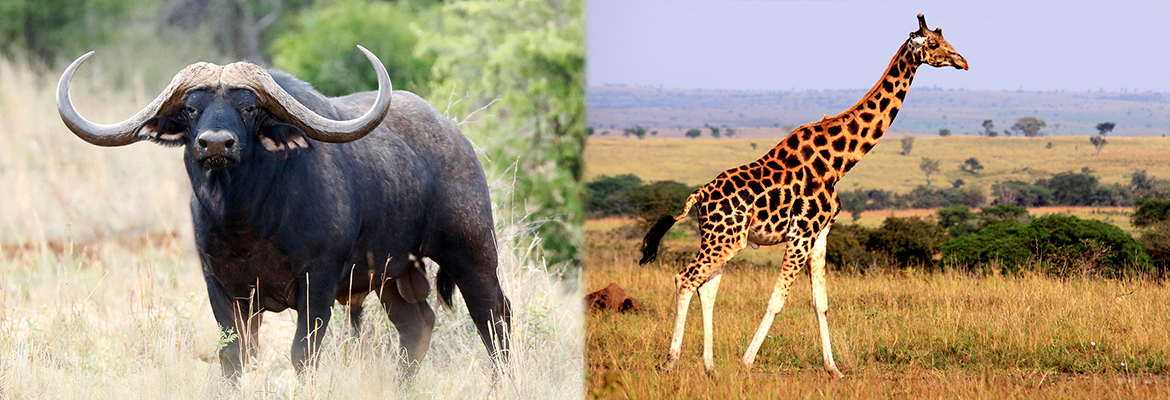
The African Buffalo is a massive and strong bovine with shoulder heights of up to 1.5 meters and a mass of 750 kilograms. Both sexes have horns, with the bulls’ horns having a heavy boss and upward bent horns.
Buffalo herds may have a big effect on the veld’s ecology. As a bulk grazer, they are in charge of transforming long grasslands into short grassy environments that are more suitable for other browsers with more selective feeding habits.
Lions are the main predators. When one of the herd members is threatened, the rest of the herd will run to its defense. A group of buffalo is more than capable of repelling an assault by an entire pride of lions. Hunters consider a wounded buffalo bull as the most lethal, which is one of the reasons why this species is included in the so-called “big five.” Many hunting adventures, myths, and legends are based on this trait.
Burchells Zebra
The body stripes are less and wider than those of the Cape Mountain Zebra, and they stretch across the belly. Leg striping is not as noticeable. At the hip, he stands 1.3 to 1.4 meters tall and weighs 300-320 kilograms. They have rounded ears that measure 160-170 mm in length. Between the ears, the front part of the mane forms a black tuft.
It is primarily a grazer that feeds in areas with short grass. Zebras have a solid, sensitive upper lip that they use to collect herbage by collecting it between the lip and the lower incisors before plucking it. Burchell’s Zebras live in small groups, usually consisting of one stallion and one mare with their offspring. Bachelor classes are made up of non-breeding stallions. Stallions in the herd range in age from four to twelve years old. Family groups congregate in large numbers around water holes and preferred grazing areas.
They are sometimes seen alongside wildebeest, other plains antelope, and baboons.
You can see these animals while on a safari after your stay with us.

Recent Comments